Water treatment is where well owners get oversold. The industry's favorite customer tests nothing, fears everything, and buys a five-stage "whole-house solution" for problems they don't have. The defense is simple: test first, then buy only the equipment that matches the results. Here's what each real problem costs to fix in 2026.
Treatment costs by problem (2026, installed)
| Your test shows | The fix | Installed cost | Running cost/yr |
|---|---|---|---|
| Hardness (scale, soap scum) | Ion-exchange softener | $1,500 – $4,000 | $50 – $150 (salt) |
| Iron / manganese (stains, metallic taste) | Air-injection oxidizing filter | $1,500 – $3,500 | minimal |
| Coliform bacteria | UV disinfection (+ prefiltration) | $700 – $1,500 | $80 – $120 (lamp) |
| Arsenic, nitrate, lead (drinking water) | Reverse osmosis at kitchen tap | $300 – $1,500 | $50 – $100 (filters) |
| Sediment / grit | Spin-down or cartridge prefilter | $150 – $600 | $20 – $60 |
| Rotten-egg smell (hydrogen sulfide) | Oxidizing filter or aeration | $1,500 – $3,500 | minimal |
| Low pH (blue-green stains, pinhole leaks) | Acid neutralizer (calcite) | $1,000 – $2,500 | $50 – $150 (media) |
| PFAS | Point-of-use RO or whole-house carbon | $800 – $3,000+ | $100 – $300 |
The order matters: how a treatment train stacks up
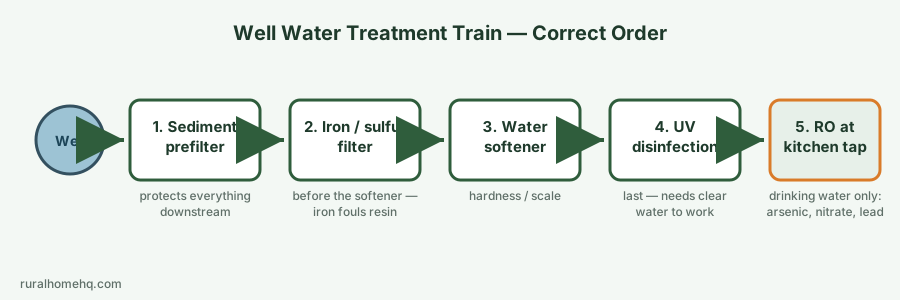
Equipment works in sequence, and getting the order wrong wastes money and shortens equipment life. The standard chain for well water:
- Sediment prefilter — protects everything downstream from grit.
- Iron/sulfur filter — before the softener, so iron doesn't foul the resin.
- Softener — hardness removal.
- UV unit — last in line for the whole house, because UV needs clear water to disinfect reliably.
- RO at the kitchen tap — polishing only the water you drink and cook with; whole-house RO is almost never justified in a home.
Where homeowners overpay
- Free in-home "water tests": a salesperson's hardness demo is a sales tool, not a lab panel. It cannot see arsenic, nitrate, lead, or bacteria — the things that matter. Insist on a certified lab report (here's how) before signing anything.
- Whole-house solutions for drinking-water problems: arsenic or nitrate only matter in water you ingest. A $600 kitchen RO solves what a $6,000 whole-house system oversolves.
- Proprietary media and lifetime contracts: big brands sell decent hardware bundled with locked-in service. Independent local dealers install standard equipment (Fleck/Clack valves, standard media) that any plumber can service — usually 30–50% cheaper over ten years.
- Oversized softeners: size follows people × hardness, not the salesperson's default. Run your numbers through our water softener size calculator before any showroom visit — a properly sized unit regenerates efficiently; an oversized one wastes salt and water.
Related reading
- Well water testing: what to test, when, and what it costs
- Shock chlorination: fixing a bacteria hit yourself
- Well pump replacement costs
Frequently Asked Questions
How much does a whole-house water treatment system cost for well water?
It depends entirely on what your water test shows. A softener alone runs $1,500–$4,000 installed. A typical "well water package" (softener + iron filter + sediment prefilter) runs $3,000–$7,000. Add UV disinfection ($700–$1,500) for bacteria or reverse osmosis at the kitchen tap ($300–$1,500) for arsenic/nitrate/lead.
Should I buy water treatment before testing my well water?
No — that's buying medicine before the diagnosis. A $150–$300 certified lab panel tells you exactly which problems exist and how severe they are. Treatment sized to a guess wastes money in both directions: paying for capacity you don't need, or under-treating a real health risk.
Do water softeners remove iron from well water?
Softeners remove modest amounts of dissolved (clear-water) iron — roughly up to 1–3 ppm depending on the unit — but they do it at the cost of resin life. Higher iron, or iron that appears as visible rust particles, needs a dedicated iron filter (air-injection oxidizing filters, $1,500–$3,500 installed, are today's standard).
Is a UV system worth it for well water?
If your well has ever tested positive for coliform — or sits in fractured bedrock, near a septic system, or floods — a UV unit ($700–$1,500 installed, ~$100/year for lamps) is the most reliable continuous disinfection with no chemicals. It requires clear water to work, so it pairs with sediment/iron filtration, and it does not remove chemicals or metals.