Once you understand what actually happens between your toilet and your lawn, every piece of septic advice — pump on schedule, don't flush wipes, keep trucks off the field — stops being folklore and starts being obvious. Here's the whole journey, in plain English.
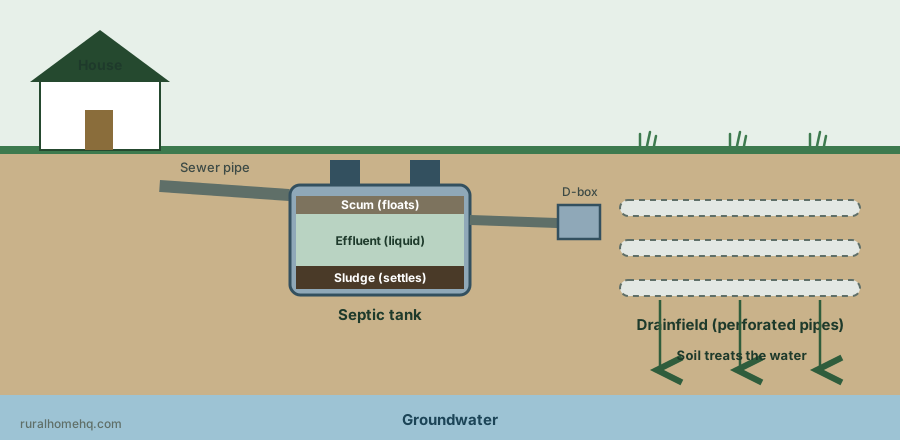
Stage 1: The tank — a settling pond, not a treatment plant
Everything you flush flows into a buried, watertight tank (usually 1,000–1,500 gallons — here's what yours should be). Inside, physics does the first job: solids sink to form the sludge layer, fats and grease float to form the scum layer, and the relatively clear liquid in the middle — effluent — is what moves on. Anaerobic bacteria slowly digest the sludge, shrinking it, but never eliminating it. That's why every tank eventually needs pumping: you're removing the indigestible remainder.
Two humble components do critical work: the inlet baffle stops incoming water from short-circuiting across the tank, and the outlet baffle keeps scum and solids from escaping to the drainfield. A broken outlet baffle — a $300–$900 fix — is one of the most common ways drainfields get ruined.
Stage 2: The drainfield — where treatment really happens
Effluent leaving the tank is still dirty water — teeming with bacteria and nutrients. It flows into the drainfield: perforated pipes laid in gravel trenches, spreading the water over a large soil area. As effluent trickles down, soil does what a municipal plant does with machinery: physical filtration catches particles, soil microbes consume pathogens and organic matter, and chemical binding in the soil captures some nutrients. By the time the water reaches groundwater, it's been treated.
This is why the soil is the system — and why field size follows soil type (estimate what your site needs). Too much water too fast (a running toilet, marathon laundry days), solids escaping the tank, or compacted soil from vehicles — all defeat the treatment zone, and the field "fails": water surfaces instead of soaking. Watch for the seven warning signs.
Variations you might have
- Pumped systems: a pump chamber lifts effluent to a field that's uphill or distant.
- Mound systems: the treatment zone is built above grade in engineered sand — the answer to high water tables and shallow bedrock.
- Aerobic treatment units (ATUs): an air pump supercharges bacteria to treat wastewater to a higher standard in a smaller footprint — common in Texas and on tight lots. They need electricity and maintenance contracts.
- Sand filters, drip dispersal, peat systems: engineered alternatives for difficult sites — see our state-by-state guides for where each is common.
The maintenance logic, derived
Now every rule explains itself:
- Pump on schedule — sludge and scum accumulate; when they reach the outlet, they escape and clog the field.
- Don't flush non-biodegradables — they can't be digested, so they fill the tank faster and jam baffles.
- Fix leaks fast — a running toilet floods the field with clean water, keeping it saturated and untreated sewage moving too fast.
- Keep vehicles off the field — compacted soil can't breathe or absorb; crushed pipes don't distribute.
- Space out laundry — hydraulic load, again. The field needs recovery time between soakings.
Frequently Asked Questions
Where does the water go after the septic tank?
Clarified wastewater (effluent) flows from the tank outlet to the drainfield — a network of perforated pipes in gravel trenches. It seeps into the soil, where microbes and filtration finish the treatment before the water rejoins the groundwater. The soil is the real treatment plant; the tank is just the settling stage.
Do septic tanks need bacteria added?
No. Every flush delivers all the bacteria the tank needs. Independent university research has not shown additives to reduce pumping needs, and some products harm the system by re-suspending solids that then clog the drainfield.
What is the biomat in a drainfield?
A thin biological layer that forms in the soil at the trench interface. A healthy biomat is part of treatment — it filters and digests pathogens. An overloaded biomat seals the soil so water can't pass, which is what "drainfield failure" usually means physically.
Why does my septic system have a pump?
When the drainfield sits higher than the tank (or far away), gravity can't deliver the effluent, so a pump chamber lifts it. Pumped systems work well but add a failure point — the pump ($800–$2,500 to replace) and its float switches deserve an alarm and periodic checks.